I knew as soon as I listened to the voice mail my mom left for me.
Usually they last upwards of two minutes, covering all of the points she intended to discuss if I had answered the phone, leaving nothing of substance to talk about when I call back.
This time, though, the message was brief and cryptic: “Nick. Give me a call back when you get this. I have something to tell you.”
My childhood cat, Tom, was dead.
It’s something we had feared/expected for a while. He was frail. You could see his ribcage through the matted fur on his stomach. He had trouble jumping from the floor to the couch and moved like you would expect a 19-year-old cat to move.
I had just seen him because I visited my parents in Arizona for Christmas this year, along with my roommate Matt. I’m glad I got that chance. I spent the morning before my flight saying my final goodbyes, knowing he probably wouldn’t be around the next time I traveled west.
I didn’t want to, but I called my mom back. She picked up the phone and her voice cracked upon “Hello." “The cat?” I asked. Already knowing. “The cat,” she said and broke into tears. Then we sat in silence for a bit before she said she wished she could hug me.
It was harder for her than it was for me. She was the one who lived with Tom. I hadn’t been in the same house with him for more than a vacation stay since college.
The shocking part was that he passed while my parents were in Philadelphia visiting family. The cat-sitter left Tom wrapped in a blanket and wrote a note to my parents about what happened. My guess is the sitter didn’t want to ruin their vacation by calling with the grim news. Still, that got to them. That they weren’t there with him until the end. My mom, especially. But even my dad, who rarely cries. They made preparations immediately for a backyard burial.
As I laid in bed listening to my mom talk about how peaceful he looked, how he went out on his own terms, the memories flooded back. Tom was a gift from my parents to me when I was in kindergarten.
It’s funny how pets are intertwined in our lives. As I started to think about Tom, I didn’t think about his glory days of being able to leap on top of the microwave or running recklessly up the stairs to chase a laser pointer. Which, it seems, is the typical pattern for human deaths. Someone close to us passes away and we remember them for who they were, what they used to be like.
Instead, I found myself remembering my own childhood, not Tom’s.
I remembered my 12th birthday party, the one where we played street hockey until the sun set and then came inside to eat greasy pizza. That day, my friend Pat got scratched pretty bad on the arm by Tom. He never forgave him.
I remembered the Super Bowl when the Eagles lost to the Patriots. All my close friends and my family, including my grandfather (who has been an Eagles season ticket holder for decades) were gathered in my living room to watch the game. Occasionally, Tom would sprint across the floor on his way upstairs. Then back downstairs to eat. He didn’t like big crowds.
I remembered playing wiffle ball in the backyard, which happened to have the perfect dimensions for Home Run Derby (until we outgrew it), and hearing my parents yell from the front door. “Dammit, Tom!” He ran outside again. Sprinting toward momentary freedom before being corralled and returned inside to plot his next escape. I took another swing.
I remembered watching baseball late at night, sprawled out on the couch with Tom by my feet, his head tucked under his paw. Perhaps he was shielding his eyes from another inevitable Phillies loss.
I remembered cleaning his litter box. An early lesson in responsibility (though my parents ended up being far more responsible than I was).
I remembered the day my grandmother died and I came home and petted Tom on the head for a long time. Somehow, he felt what I was feeling, and we both realized it was going to be OK.
I remembered the day I moved to York, Pa. to take my first real job. Tom rubbed against my leg. I sat with him for a long time. I knew he wouldn’t be happy about me leaving. I knew it wouldn’t be easy for me to grow up, nor would it be easy for him to live without me.
I have another cat now. Her name is Hallie and I got her the night Roy Halladay pitched his perfect game.
I know the day will come, just as it did with Tom, when it will be difficult to say goodbye.
As my mom was about to hang up the phone and begin preparing for the funeral, she said something that stuck. “He lived a good, long life,” she said. “He wasn’t perfect. But we loved him.”
If we could all be so lucky.
Showing posts with label life. Show all posts
Showing posts with label life. Show all posts
2.26.2012


12.14.2011
The living map
I often think about this idea of a living map.
It wouldn't exist in reality, only digitally, but it would include a very specific, very interesting (to me, at least) feature: Wherever you've walked, driven, flown, sailed, trained, etc., the map would record the exact path of the trip and place a red footprint or blue tire mark or a green flight path on the page. So ultimately, you'd end up with a sort of heat map of the precise places you've set foot on this earth (as well as the modes of transportation you used to get there).
What fascinates me most about this idea would be seeing the disparity between the marks placed near your home (naturally a high volume of footprints, tire tracks, etc.) compared to somewhere you've only been once -- like that open field you traveled to and played touch football or a random concert hall on the west coast. It could take hours to explore your own map, and, literally, re-trace your footsteps.

There's bound to be one little speck of a spot that's not filled in on your front doorstep. After all the times you've trekked in and out, you might never have stepped on that one spot. Would you make it your mission to step there after seeing the map? Or let it happen naturally? Or consciously avoid it? Would you set target goals for optimum stepping places? Would you take a different flight from Chicago to Los Angeles just to cross over a state in which you've got no representation? Or would you shun the technology altogether?
I'm sure innovators aren't too far off from being able to design such a map. After all, our every move already is being documented by our phones. But for now, maybe I'll just slap some red paint on the bottom of my shoes and see where that gets me.
It wouldn't exist in reality, only digitally, but it would include a very specific, very interesting (to me, at least) feature: Wherever you've walked, driven, flown, sailed, trained, etc., the map would record the exact path of the trip and place a red footprint or blue tire mark or a green flight path on the page. So ultimately, you'd end up with a sort of heat map of the precise places you've set foot on this earth (as well as the modes of transportation you used to get there).
What fascinates me most about this idea would be seeing the disparity between the marks placed near your home (naturally a high volume of footprints, tire tracks, etc.) compared to somewhere you've only been once -- like that open field you traveled to and played touch football or a random concert hall on the west coast. It could take hours to explore your own map, and, literally, re-trace your footsteps.
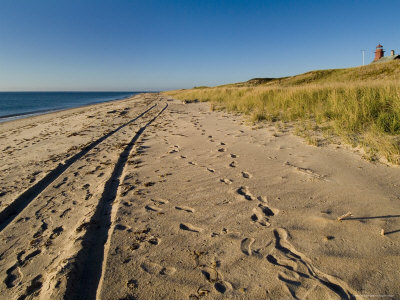
There's bound to be one little speck of a spot that's not filled in on your front doorstep. After all the times you've trekked in and out, you might never have stepped on that one spot. Would you make it your mission to step there after seeing the map? Or let it happen naturally? Or consciously avoid it? Would you set target goals for optimum stepping places? Would you take a different flight from Chicago to Los Angeles just to cross over a state in which you've got no representation? Or would you shun the technology altogether?
I'm sure innovators aren't too far off from being able to design such a map. After all, our every move already is being documented by our phones. But for now, maybe I'll just slap some red paint on the bottom of my shoes and see where that gets me.
Subscribe to:
Posts (Atom)