Luckily, my roommate Matt has a knack for knowing when the good shows roll East/he has emails sent to him by a data congregation service, so I've started attending more performances in the past year. Mainly Bela Fleck and the Flecktones.
The Flecktones' bass player is Victor Wooten. Since May, I've seen Wooten live three times -- twice with the Flecktones and once with his own group. I walked away from all three of those concerts awestruck, firmly believing that I just witnessed the finest musical talent I ever had and, potentially, ever will.
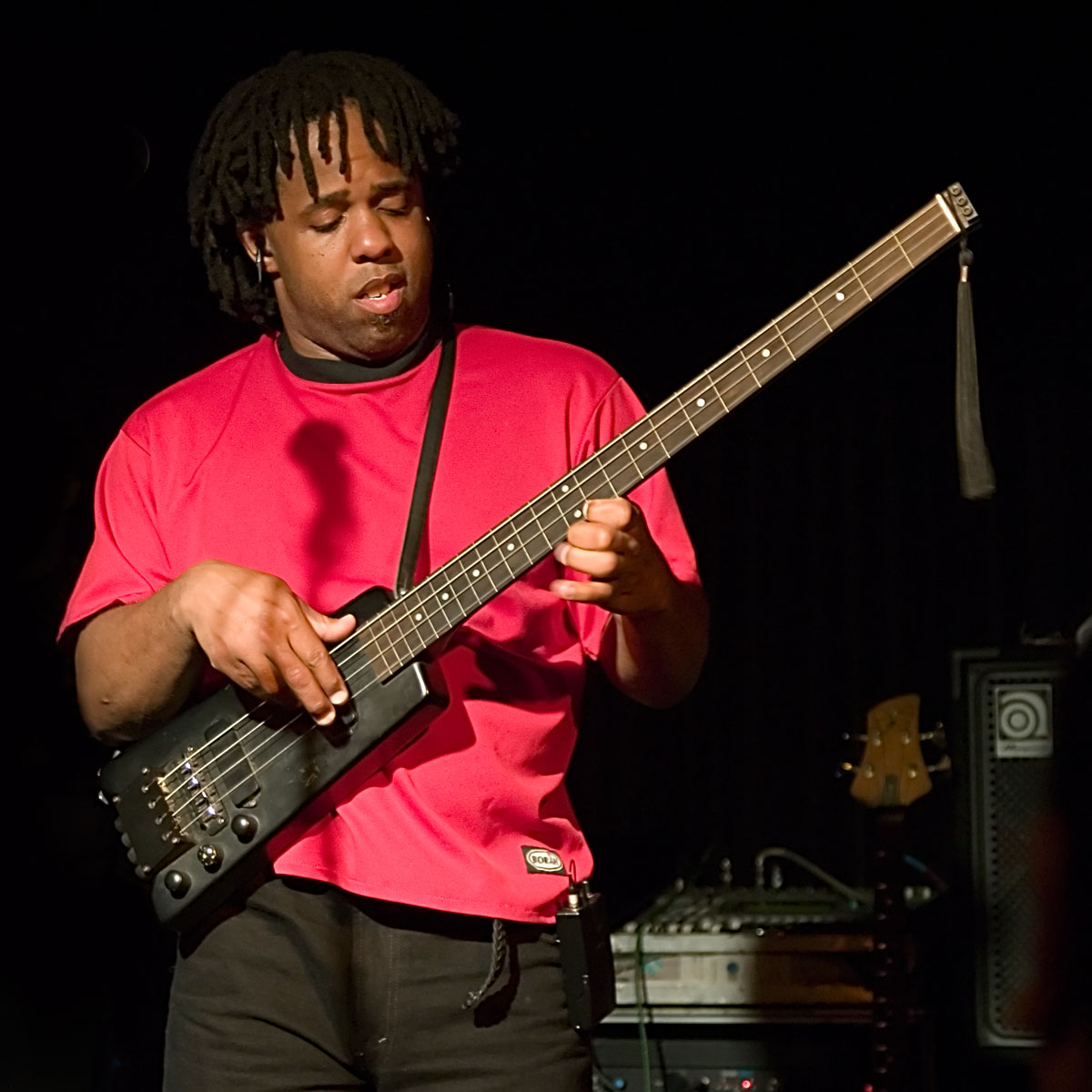
While mentally drafting this post, I focused on the feeling or object to which I could compare Wooten. Writers love similes, and it seemed only natural that someone with Wooten's level of skill and ability deserved a good one. But brainstorm after brainstorm fell short. I was left only with the image of Wooten's fingers gliding across the fret, his other hand effortlessly plucking the heavy strings. It was at that point where I stopped trying to compare. Instead, Wooten, for me, had set a new standard -- "This certain thing is as beautiful as Victor Wooten's bass playing."
One of the concerts I attended was at Wolf Trap, an outdoor venue in the D.C. suburbs. During that concert, where the night sky was illuminated by thousands of distant stars, the Flecktones played a song called "Big Country."*
*This particular song is Matt's favorite. I've heard it upwards of 75 times since moving in with him in February. Matt, a man who claims to have Life's Playlist -- music for any moment, emotion or situation -- often forgoes variation for familiarity. In turn, that makes Big Country the apartment's go-to song for any moment where we're searching for some extra inspiration, joy or serenity.
The band started playing and I closed my eyes. I laid back on the sprawling lawn and tried as best I could to empty my brain -- which usually is a difficult task, especially given the random clamor of people packed like sardines surrounding me. That night, though, it proved remarkable easy. About two minutes into the piece, Wooten played a brief eight-bar solo. The low soothing tones he created had none of the so-often-heard metallic clang of the bass. The melody was warm and constant. Soon the only notes that existed in my mind were those from Wooten's fingers. His sound was a forceful boom, loud enough to shake my organs, but not so boisterous as to annoy me. It was like the music evaporated through my skin, not just through my ears. I imagined Wooten's notes traveling well beyond the reach of the amplifier stacks, beyond Virginia, beyond everything, to a place where they could join some of nature's other mystifying elements. The passage was that powerful.
Since that concert I've spent a lot of my time scouring YouTube, watching videos of Wooten play. And what stands out most to me isn't necessarily his remarkable technical ability (though that, in its own right, is amazing and clearly places him among the top five bass players of alltime). It's his emotion. The video below provides a good example:
After the brief interview at the beginning of the video, Wooten starts playing a piece from his album Show of Hands called "U Can't Hold No Groove... [if you ain't got no pocket]."*
*In music, playing "in the pocket" is generally accepted as the tightest form of performing. It's the period when the band members are most in sync. The pocket is created by the rhythm instruments (bass, drums, piano), so naturally, Wooten's pockets are extraordinarily deep.
When the interviewers leave the picture, Wooten's still smiling and laughing from their conversation. He dips his head as he laughs, the camera zooms in on the bass and Wooten beings playing. It's when the camera refocuses on Wooten's face (around 0:52) that struck me. His demeanor shifts in a remarkable way. His expression is such that he's no longer in the shallow world of interview pleasantries or corny jokes. He has inserted himself into his own realm, where the music and Wooten are one, his fingers dancing, moving in their own version of time and space. Forget his smile and his head-nodding. Plenty of artists do that well, and it almost always conveys a deeper connection with the music. What I couldn't stop looking at were his eyes. The instant he plucks those strings, his eyelids lower, and he slips into a trance. His gaze, for the most part, remains locked on his left hand. He looks into a lover's eyes. He stands awestruck by a moving piece of art (which, in this case, happens to be of his own creation). Hell, even his breathing appears to be in time with the groove. With that stare, he's not looking at his frets and wondering where to place his hand, he's simply lost in the moment. Seconds before that, he answered questions on camera. It's that instant ability to transform that makes Wooten so appealing to me. Makes him so unique. So magical.
In an interview for the website JazzTimes, Wooten said this:
"I’m not really doing my music for the crowd. I’m doing the music I want to do, and I’ll allow the crowd to think whatever they want to think about it. If they love it, great, if they hate it, great. That’s their choice. The way I can be the most truthful is by being me. If I’m just trying to please the public, then I might not be truthful to myself. For me, the way I’m going to produce the best music is to be really truthful to who I am, and then allow the public to believe or say whatever they want about the music."Matt and I often discuss the surreal nature of Wooten's style and I remember he once told me, "He is the bass. It's a part of him." Seems easy to be truthful to your being if you are the instrument itself...
As I left the most recent Flecktones concert, which was, sadly, a bit disappointing, I thought about Wooten and how I longed for another moment like the one I experienced at Wolf Trap. It seems, however, that for those experiences -- the most-meaningful-when-you-least-expect-it sort of things -- they can't be forced. They can't be recreated. Nor can they be manufactured. They're, simply, remembered.
Which is why, I guess, no matter where you are or what you're doing, sometimes you've just gotta sit back, close your eyes and listen.


4 comments:
It's true that no analogy is worthy of relegating Wooten to the first thing that's being compared. But despite his status as king of all things, we'll never hear a phrase like "Michael Jordan is the Victor Wooten of basketball" become common.
We like to debate whether Dave Matthews is more popular than Wooten & the Flecktones. I think the real measure is in potential. More people have heard of Dave than Wooten and Fleck. But given the chance to hear them all out, I think more people would enjoy and respect Wooten and Fleck more because of exactly what you talked about in this post -- the inherent emotions in their playing. They're not playing for anyone but themselves, whereas all the rest are showmen for paying customers.
I think there are emotions like Wooten and Fleck possess with plenty of other artists, but I'm not sure I've seen them so readily, or heard them expressed as much. That might be the main difference. It's easy to be a group that "doesn't care" what anyone thinks about your music and just plays for yourself when the demand for music isn't so overwhelming (like it might be for someone like Dave Matthews). They're in the perfect pocket of popularity to get by with maintaining this mentality, but still entertaining the masses with brilliant, brilliant music.
I'm not sure why we're railing on Dave here. The one thing they bring to the stage, if they bring nothing else, is emotion and energy. It's what draws people to the shows. Emotion is inherent in all kinds of music. And it's a lot like fingerprints. I didn't enjoy the latest Bela Fleck concert because for me it was devoid of emotion. It didn't speak to me. It spoke to Negrin. Dave speaks to me, not Negrin.
Sorry you had to post this twice ;)
-AAW
I thought that Fleck concert was one of the more emotionless ones I've been to, to be honest... (Wooten excluded, haha) and certainly was nothing close to Wolf Trap. By comparison, I think with Dave, part of the magic of the emotion in his playing is also the emotion of those at the concert. At Fleck, it's taboo to yell or scream or sing or clap (like it was at Strathmore), while with Dave, everyone can link to each other through their words and actions and enjoy the music on another level... And I didn't mean to come across as railing on Dave, I meant to say just that there's a very different pressure that comes along with playing at his level of recognition (nationally and worldwide) as opposed to Fleck's.
Post a Comment